Application Maintenance & Support
for Mid-Market Enterprises

Software you depend on shouldn't depend on whoever happens to remember how it works. We take on running systems — including ones we didn't build — with defined response times, monitoring that pages a human before your customers call, and a backlog where dependency patching and the slow accumulation of technical debt get addressed instead of deferred indefinitely.

The problem

Critical systems shouldn't rely on one person's memory

Someone knows why that job runs at 3am and which service to restart first. Nothing is written down, patching keeps getting deferred for feature work, and you find out about outages when a customer calls. That's not a tooling problem — it's an ownership one.

Response timesin writing

Debt addressed,not deferred

Alerted beforecustomers call
Documented ownership.Defined response.

Key-person risk

is the real single point of failure

When the knowledge lives in one head, every holiday is a risk window and every resignation is an incident waiting to happen.

Deferred

patching compounds quietly

Dependency updates skipped for a quarter become a migration project, and the security exposure grows the whole time.

Our fix

take ownership, write it down

We take on running systems — including ones we didn't build — with monitoring, runbooks and a backlog where maintenance actually gets done.

HOW WE DO

Preventive Maintenance

Dependency and security patching on a standing monthly schedule, plus backup restores actually exercised rather than assumed. Maintenance gets its own allocation so it stops competing with feature work and losing.

Bug Fixes & Issue Resolution

Triage against agreed severity tiers, so a checkout failure and a cosmetic defect don't sit in the same queue. We fix the cause and write up anything material, including what we changed and why.

Performance Optimization

We profile the slow paths under real traffic instead of guessing, then fix the query plans, caching and resource limits behind them. Latency is measured before and after, so the improvement is evidence rather than an impression.

Security Updates & Monitoring

Known-vulnerability tracking across your dependency tree, with patches tested and shipped rather than logged and deferred. Access to your systems stays least-privilege and revocable by you at any moment.

System Upgrades & Enhancements

Runtime, framework and platform version upgrades rehearsed in a lower environment before production, with a tested route back. Enhancements are scoped into the retainer allocation or quoted separately, never quietly absorbed.

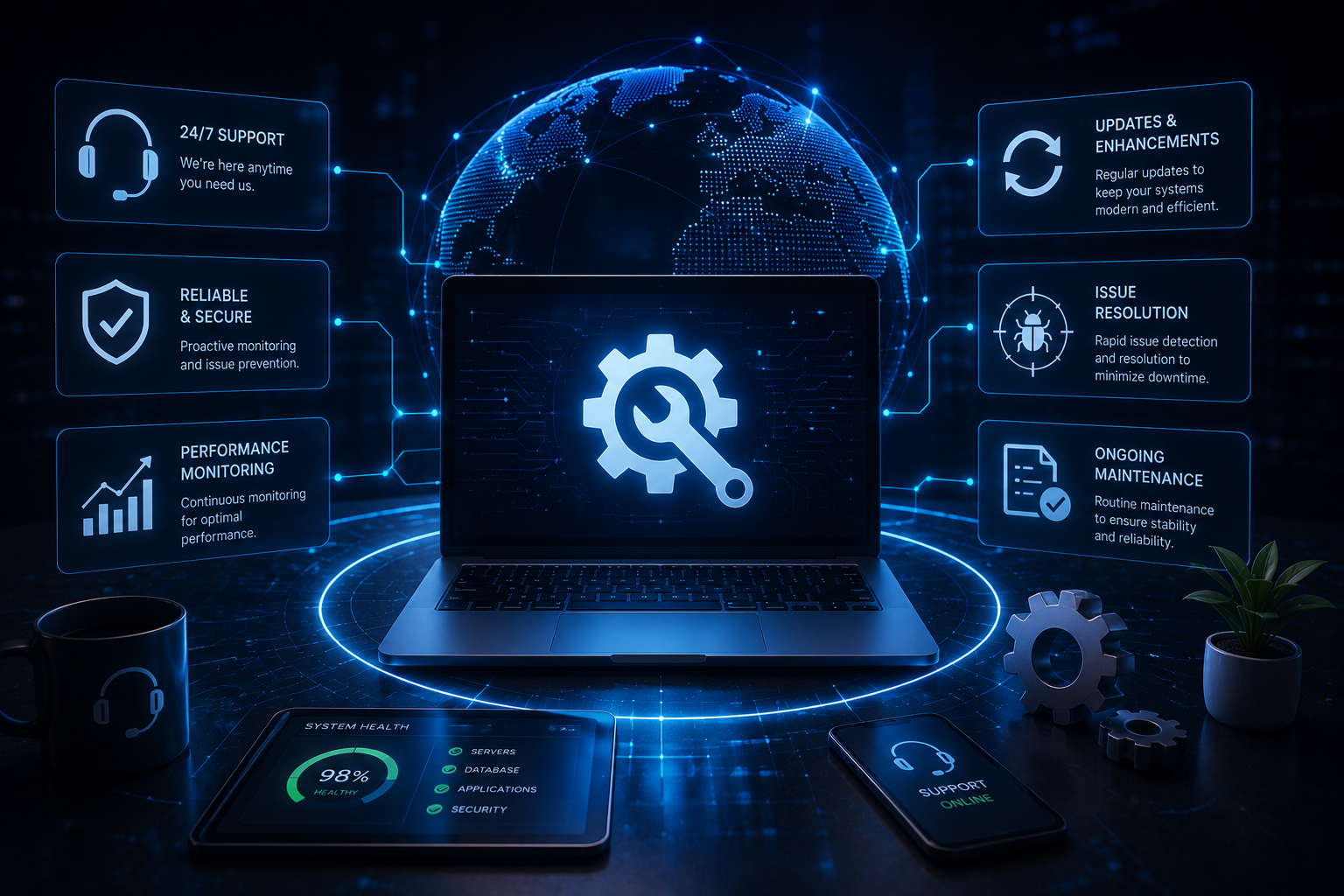
24/7 Technical Support

Named on-call responders reachable through an agreed escalation path, with response targets set per severity tier and written into the contract. Monitoring pages a human on the paths that matter, so we're often working the problem before you call.

What changes

Outcomes we hold ourselves to

Support is bought on commitments rather than promises, so these are the terms we work to. Exact response times are agreed per engagement and written into the contract.

Minutes

to acknowledge a critical issue

Response targets by severity, agreed up front and reported against — not a best-effort inbox.

Before the call

not after it

Monitoring and alerting on the paths that matter, so we're already working the problem when you hear about it.

Every month

dependencies patched

Security and dependency updates on a standing schedule, so patching stops competing with feature work for attention.

Written down

before we're the only ones who know

Runbooks, architecture notes and escalation paths documented in your repository, so the knowledge is yours.

How we work

Three ways to start

The right arrangement depends on how critical the system is and how much of the load you want to keep in-house. Moving between them as things change is normal.

Managed support

For business-critical systems that need defined response times and proactive maintenance.

  • Response targets by severity, written into the agreement
  • Monitoring, alerting and incident response we own
  • Standing allocation for patching and technical debt

Timeline

Rolling, monthly

Best for

Business-critical systems

Trust & compliance

Built to survive an audit

Supporting your systems means holding access to them. How that access is controlled, and what evidence we leave behind, is part of the service rather than an afterthought.

Aligned to

GDPR
SOC 2
ISO 27001
ITIL-aligned

Least-privilege access

Named individuals with scoped, time-limited credentials in your identity provider — revocable by you at any moment, without going through us.

Every change recorded

Changes arrive through version control and your change process, so the audit trail is a by-product of how we work rather than a reconstruction.

Incidents documented

Timeline, root cause and corrective actions written up for anything material, in a form you can hand to a customer or an auditor.

Recovery you've tested

Backup restoration exercised on a schedule, with the measured recovery time recorded rather than assumed from the documentation.

Yes — that's most of this work. The assessment exists precisely for that case: we go through the system, its dependencies and the parts nobody documented, and tell you what supporting it properly involves before either of us commits. Occasionally that conversation concludes that something needs remediation before it can be supported responsibly, and we'd rather say so up front.

Named on-call engineers reachable through an agreed escalation path, with response targets by severity written into the contract. It's worth being honest that round-the-clock cover costs meaningfully more, and plenty of systems don't need it — the assessment includes a view on whether yours does.

A hire gives you more capacity; this gives you coverage. One person can't be on call every week of the year, and their knowledge leaves when they do. For a system that needs a couple of days of attention a month plus someone reachable when it breaks, a retainer is usually both cheaper and more resilient. If you need continuous feature development, a hire is the better answer and we'll say so.

No. Documentation, runbooks and code stay in your repositories throughout, access is yours to revoke, and agreements run monthly with notice rather than multi-year. The intention is that leaving us is inconvenient rather than dangerous.

Yes, within an agreed allocation. Every retainer includes standing time for patching and technical debt; larger enhancements are either scoped into that allocation or quoted separately so routine maintenance doesn't quietly get eaten by feature work — which is how systems end up unmaintained in the first place.

BMI

Building intelligent digital products across AI, security, and cloud.

© 2026 BMI. All Rights Reserved.